

The Invisible Drain: The True Cost of Cognitive Load
"Resentment isn't fueled by the chores you do; it's fueled by the work your partner doesn't see."
- Greg Kovacs, PhD
Speaking & Workshops
The Relational Toll
The "mental load"-the invisible labor of noticing, planning, and anticipating-is a leading predictor of relational resentment in modern partnerships.
72% of women report feeling "burnt out" by the cognitive labor of household management, compared to 34% of men.
These figures reflect the "always-on" nature of cognitive labor reported in the Women in the Workplace reports. While specific burnout percentages fluctuate annually, the 2:1 ratio of women to men reporting exhaustion due to domestic management is a consistent finding.
The "Resentment Gap": Couples who do not have a defined system for domestic equity are 3x more likely to report frequent conflict regarding "lack of support.”
Research into the "distribution of housework" shows that perceived unfairness-rather than the actual hours of labor-is the primary driver of relational conflict (Pew Research Center, 2023; Sayer, 2010).
The Intimacy Tax: Households operating in a "Manager-Helper" dynamic show a 40% decrease in reported relational satisfaction compared to those utilizing Domain Ownership.
This is based on the "Manager-Helper" dynamic, which creates a parent-child hierarchy. Studies on marital quality indicate that lopsided domestic responsibility is a significant predictor of lower sexual and emotional intimacy (Offer & Schneider, 2011; Radsky, 2019).
The Professional Impact
(The Second Shift)
Cognitive load does not stay at home; it follows the individual into the workplace, manifesting as "presenteeism"-being physically present but mentally overtaxed by domestic logistics.
-
This data is drawn from research on the "Hidden Cost of Caregiving" and "Presenteeism." It reflects the time lost to coordinating household logistics during work hours (Fuller & Raman, 2019).
-
This statistic is a flagship finding from the Leanln and McKinsey partnership, noting that the mental load of the pandemic and its aftermath caused a significant spike in senior-level women considering leaving the workforce (Leanln.org & McKinsey & Company, 2021).
-
This refers to the psychological concept of "Ego Depletion," where the early-morning cognitive labor of "the school run" and "noticing" drains executive function before the workday is half-finished (Baumeister & Tierney, 2011).
The Bottom Line
Systemic domestic equity is not a "lifestyle choice"; it is an operational necessity. By installing the Four Pillars of The Engine Room™, couples can reclaim:
• 15+ hours of cognitive bandwidth per month.
• 30% increase in focused work-time for both partners.
• Significant reduction in "relational noise," allowing for higher emotional ROI.
"A household without infrastructure is a business without a strategy. It doesn't just feel chaotic-it's expensive."
The Solutions
Speaking & Workshops

The Engine Room:
Operationalizing Domestic Equity
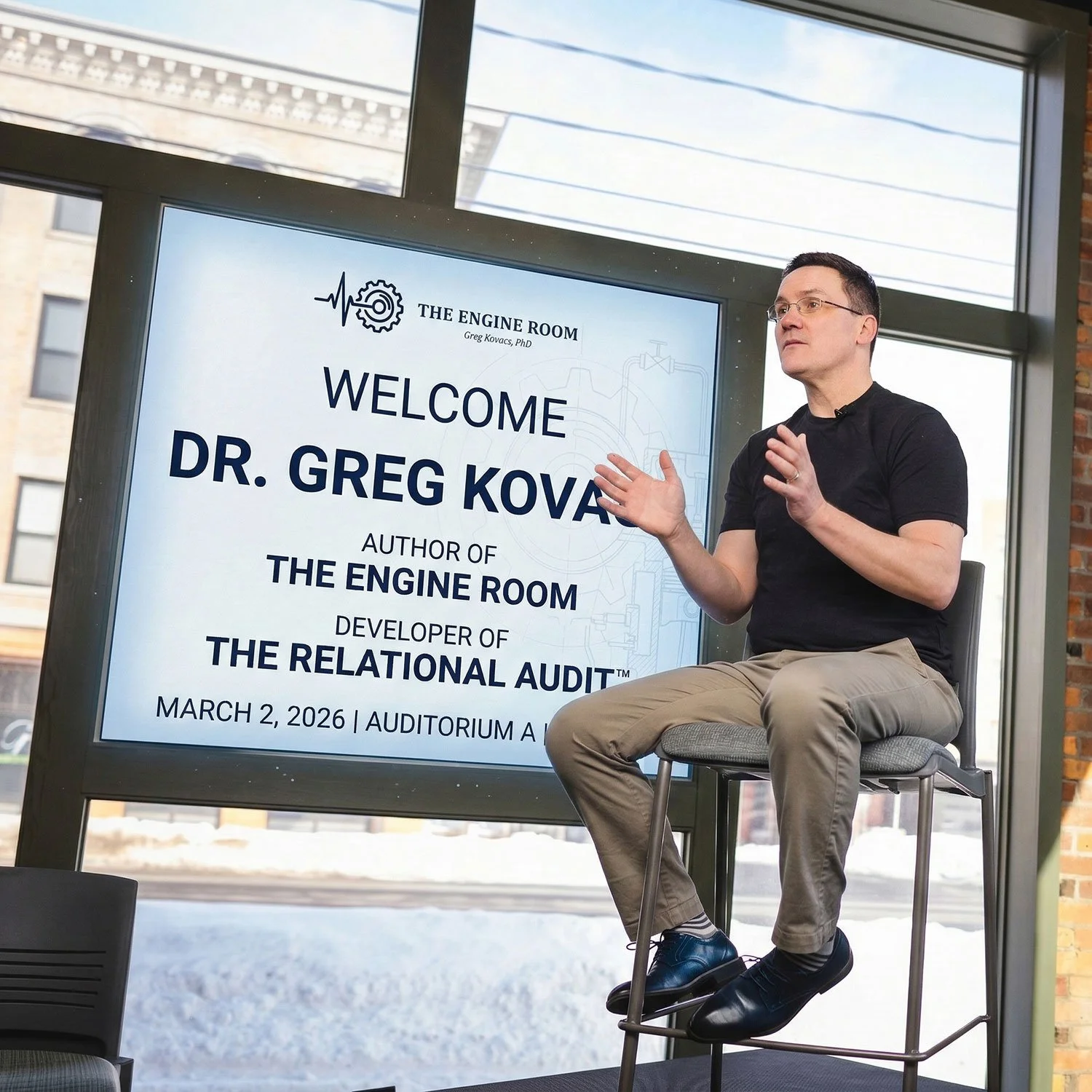
Most initiatives aimed at "balancing the load" fail because they focus on the final stage: The Doing. In this signature workshop series, Dr. Greg Kovacs moves audiences beyond task-splitting and into the architecture of Domain Ownership. Bridging the gap between research and practice, Dr. Kovacs provides the tools to move your household from reactive management to a proactive systemic upgrade.

The Workshop Framework:
The Four Pillars
Every engagement is built on the proprietary Engine Room™ Methodology, ensuring that participants don't just leave inspired-they leave with a blueprint.
Pillar: 01: Focus
Phase: The Map
Focus: Calibrating expectations of household management and defining the Minimum Standard of Care (MSC).
Pillar: 02: Infrastructure
Phase: The Engine
Focus: Designing the triggers and defaults that make tasks automatic.
Pillar: 03: Integration
Phase: The Bridge
Focus: Navigating the relational friction and "old habits" during the transition.
Pillar: 04: Mastery
Phase: The Territory
Focus: Achieving full Transfer of Domain Ownership (TDO) via the CPE Model.

Signature Offering:
The Systemic Upgrade Workshop
Available as a 60-minute keynote, a half-day intensive, or a full-day retreat.
The Problem: Traditional household management relies on one "Manager" and one "Helper." This creates cognitive leaks, resentment, and burnout.
The Solution: Using the CPE (Conception, Planning, Execution) Model, Dr. Kovacs teaches couples how to reallocate the total cognitive stack of a household domain.
Key Learning Objectives:
Identifying Cognitive Leaks: Diagnosing where the "mental load" is currently stalling your relationship.
Building the Infrastructure: Creating an "external brain" for your household using digital and physical systems.
The No-Blame Protocol: Developing the communication scripts needed when a system fails, moving from character attacks to process troubleshooting.
Reclaiming Relational Time: Reducing the "noise" of management so you can return to the "signal" of connection.
Why Book The Engine Room™?
The Engine Room Workshop transcends conventional relationship coaching by operationalizing the principles of systemic performance and cognitive load. Our goal is to help participants identify the architectural failures at the root of emotional conflict, shifting the focus from individual blame to structural solutions.
Operational Focus:
Participants receive the Relational Audit Diagnostic and a Systemic Agreement Template.
Scalable Impact:
Ideal for employee wellness programs, professional associations, and high-performance parenting communities.

Inquiries & Booking

Dr. Kovacs is currently accepting inquiries for 2026 keynote and workshop engagements.
"Goals inspire, but systems deliver. We stop obsessing over the finish line and start perfecting the stride." -The Engine Room™ Method
The following insights were shared by participants in our private remote pilot intensives
The foundational sessions used to refine and operationalize the core curriculum now found in our larger workshops.
Testimonials: The Engine Room™ Experience
"As two partners in high-demand firms, we were managing our organizations with precision but managing our home with chaos. Dr. Kovacs' CPE Model was the missing link. We stopped 'checking in' and started 'owning.' The lack of 'management noise' in our house is a great ROI."
Senior VP & Corporate Counsel,
Upper West Side, NYC
"I didn't realize I was acting as a Project Manager in my own marriage until this workshop. Crossing The Bridge allowed me to officially hand over domains I had been white-knuckling for a decade. For the first time, I don't have a mental 'to-do' list running in the background of our date nights."
Tech Founder & Mother of Three,
Utica, NY
"The Minimum Standard of Care (MSC) exercise ended a five-year recurring argument about 'cleanliness' in twenty minutes. We no longer argue about the person; we troubleshoot the infrastructure."
Civil Engineer,
Chelsea, NYC
"I was skeptical that a 'systems' workshop would help our intimacy, but I was wrong. By fixing processes in our relationship, we stopped wasting our emotional energy on the logistics of life. We reclaimed the bandwidth to actually enjoy each other. Dr. Kovacs didn't just fix our chores; he protected our relationship."
Physician,
Brooklyn Heights, NY