
Maximize Career Performance by Managing the Household Mental Load
The mental load of domestic management acts as an invisible cognitive tax, siphoning away the executive functioning bandwidth required for high-level professional focus. Because the human brain cannot genuinely multitask, household responsibilities left unmanaged create a persistent “secondary tab” that impairs concentration during the workday and drives mid-career burnout.
Key strategies to reclaim your professional focus include:
Adopt Total Task Ownership (TTO): Move away from the “helper” model by having one partner fully own a task from anticipation to monitoring, allowing the other partner to completely close that mental tab.
Hold a Weekly Family Sync: Consolidate logistics into a single 20-minute structured block to eliminate the micro-negotiations and text-message friction that bleed into corporate hours.
Establish Minimum Viable Standards (MVS): Specify clear standards for task completion to reduce the “Gatekeeping Tax” and lower the brain’s baseline threat detection.
Why Chore Charts Fail: The Systems Science of Relational Equity and the Relational Audit™
Stop arguing about chores and start aligning on reality. Dr. Greg Kovacs breaks down the systems science of The Relational Audit™—a neutral, data-driven framework to identify your family's unique household task dynamic and reclaim your capacity for rest.
The Redline & Gatekeeping De-Escalator Worksheet
Relational Overload: What it is and How to Fix it.
Are you constantly exhausted and feeling like your partnership is a second job? Discover how to identify and fix relationship burnout in 2025 before it ruins your connection.
In this video, I break down recent research on "relational overload" to explain why modern relationships carry so much emotional exhaustion. You'll learn the three hidden causes of burnout: external stress, role strain, and intense partner demands. We also uncover the dangerous link between high overload and the urge to look for an escape hatch.
If your relationship scale is tipped because the demands outweigh your resources, we'll give you a proven two-pronged fix. Learn how to set better boundaries to cut demands and effectively "refill the tank" so your relationship can go back to being your safe zone.
The Appreciation Injection Worksheet
"Resentment is the interest paid on a debt of unacknowledged labor."
When household labor goes unwitnessed, it ceases to feel like a helpful contribution and begins to feel like an emotional debt. This creates a mathematical disconnect between the sheer effort you put into your home and the relational validation you get back—a high-friction state known as the Witness Gap.
When a partner operates in this "Ghost Role," every single task starts to feel heavier than it actually is, rapidly accelerating chronic resentment. The system isn't broken because of the work itself; it's broken because the work has become entirely invisible. To stabilize your relationship and rebalance the emotional cost of labor, your partnership requires an immediate intervention.
What You’ll Learn in This Post:
The Anatomy of the Witness Gap: Why unappreciated household labor alters your perception of effort, making daily chores feel overwhelming.
How to Avoid the Gatekeeping Loop: Stop the real-time auditing and policing that collapses trust between partners.
The Appreciation Injection Protocol: A step-by-step guide to targeting the exact tasks your partner performs that are currently being taken for granted.
Building an Economy of Gratitude: How to cultivate a resilient "relational shock absorber" so your household can handle high volume without breaking.

The Shared Reality Alignment Worksheet
Why Couples Fight Over Chores (and How to Stop)
Why are you actually fighting about chores? Discover how a "Shared Reality Gap" forces couples to double-count household labor, disagree on basic facts, and drive chronic relationship resentment.
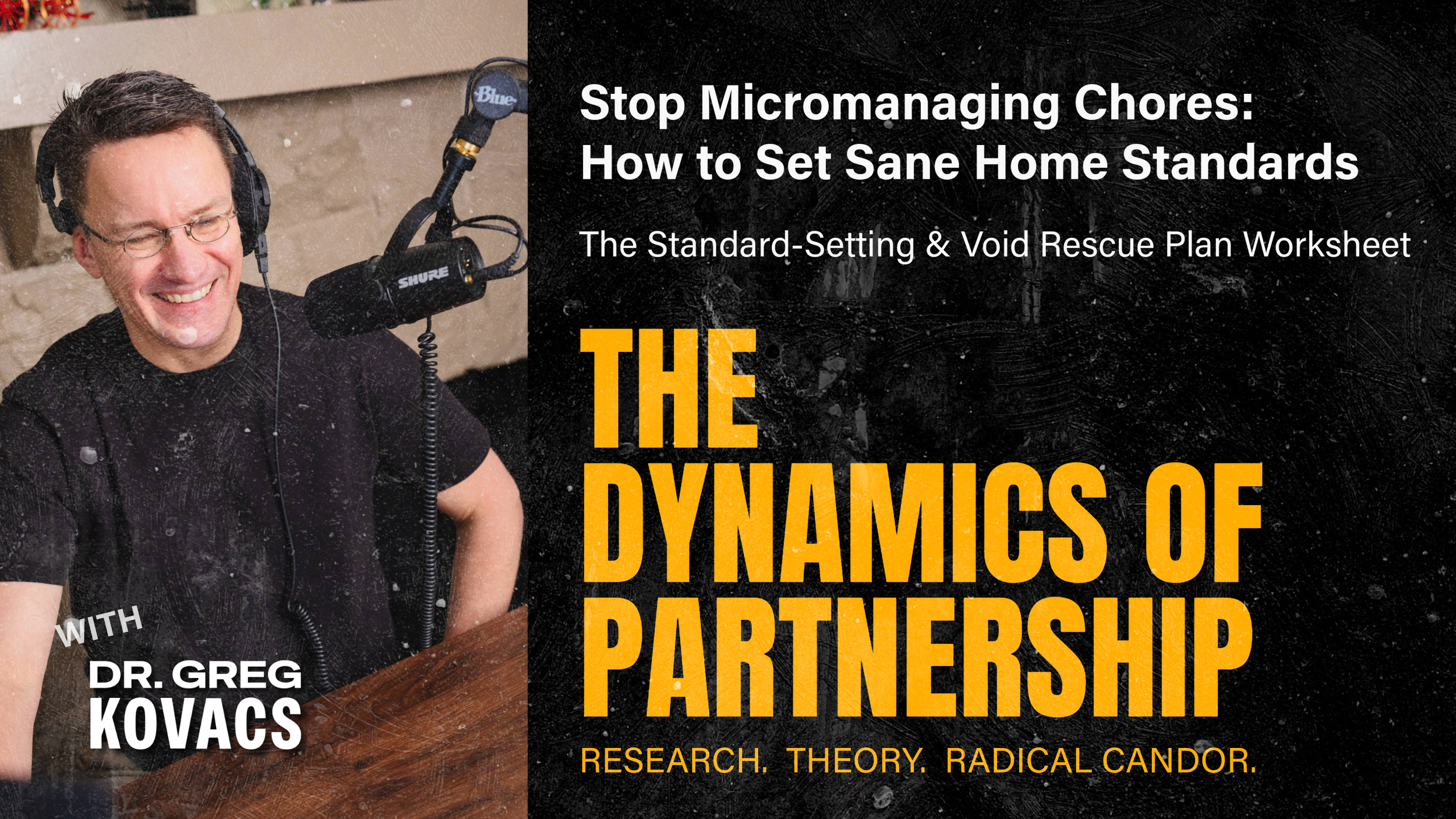
Stop Micromanaging Chores: How to Set Sane Home Standards
Saying "I might as well just do it myself" is the ultimate gatekeeping tax. You win the short-term battle for your specific preference, but you pay for it by signing up to execute that chore yourself for the rest of your life.
To break this high-friction loop, partners must run a Standards Audit to separate mandatory Clinical Standards (critical safety or financial risks, like leaving the stove on) from subjective Preference Standards (how towels are folded).
For every preference, negotiate a Minimum Viable Product (MVP)—the lowest level of completion the managing partner will accept in exchange for never having to think about that task again. Once the performing partner meets this negotiated MVP, the other partner is legally barred from critiquing, sighing, or re-doing the work. Lowering your standard on the 'how' is the only way to get permanent relief from the 'who'.